Multi-Provider LLM Support in One UI: How CachiBot Handles It
Multi-Provider LLM Support in One UI: How CachiBot Handles It
One of the hardest parts of building an AI agent is choosing a model. OpenAI’s GPT-4 is great at reasoning. Anthropic’s Claude excels at long context. Local models via Ollama keep your data private. But each provider has its own API, its own quirks, and its own pricing.
In CachiBot, I solved this with a unified provider abstraction. Here’s how it works.
The provider problem
If you hardcode your agent to OpenAI, switching to Anthropic means rewriting API calls, parsing different response shapes, and retesting everything. Multiply that by three or four providers and you have a maintenance nightmare.
A cleaner approach is to define a common interface that every provider implements:
class LLMProvider:
    def chat(self, messages: list, tools: list = None) -> LLMResponse:
        raise NotImplementedError

    def embed(self, texts: list) -> list:
        raise NotImplementedError
Then each provider — OpenAI, Anthropic, Ollama — implements that interface.
The CachiBot provider layer
CachiBot’s provider layer has three parts:
- Provider classes — one per LLM service
- A provider registry — maps names like
"openai"or"anthropic"to classes - A unified response format — every provider returns the same structure
Example: OpenAI provider
from openai import OpenAI

class OpenAIProvider(LLMProvider):
    def __init__(self, api_key: str, model: str = "gpt-4o"):
        self.client = OpenAI(api_key=api_key)
        self.model = model

    def chat(self, messages, tools=None):
        response = self.client.chat.completions.create(
            model=self.model,
            messages=messages,
            tools=tools,
        )
        return LLMResponse(
            content=response.choices[0].message.content,
            tool_calls=self._extract_tool_calls(response),
            usage=response.usage,
        )
Example: Anthropic provider
import anthropic

class AnthropicProvider(LLMProvider):
    def __init__(self, api_key: str, model: str = "claude-3-5-sonnet"):
        self.client = anthropic.Anthropic(api_key=api_key)
        self.model = model

    def chat(self, messages, tools=None):
        response = self.client.messages.create(
            model=self.model,
            messages=messages,
            tools=tools,
            max_tokens=4096,
        )
        return LLMResponse(
            content=self._extract_text(response),
            tool_calls=self._extract_tool_calls(response),
            usage=self._extract_usage(response),
        )
The agent code never calls OpenAI or Anthropic directly. It calls provider.chat().
Tool calling across providers
Tool calling (function calling) is where providers differ most. OpenAI uses a specific JSON schema. Anthropic has its own format. Local models might not support tools at all.
CachiBot normalizes tool definitions:
tool = {
    "name": "read_file",
    "description": "Read the contents of a file",
    "parameters": {
        "type": "object",
        "properties": {
            "path": {"type": "string"}
        },
        "required": ["path"]
    }
}
Each provider converts this into its own native format. The agent receives a normalized ToolCall object regardless of which model generated it.
Switching providers at runtime
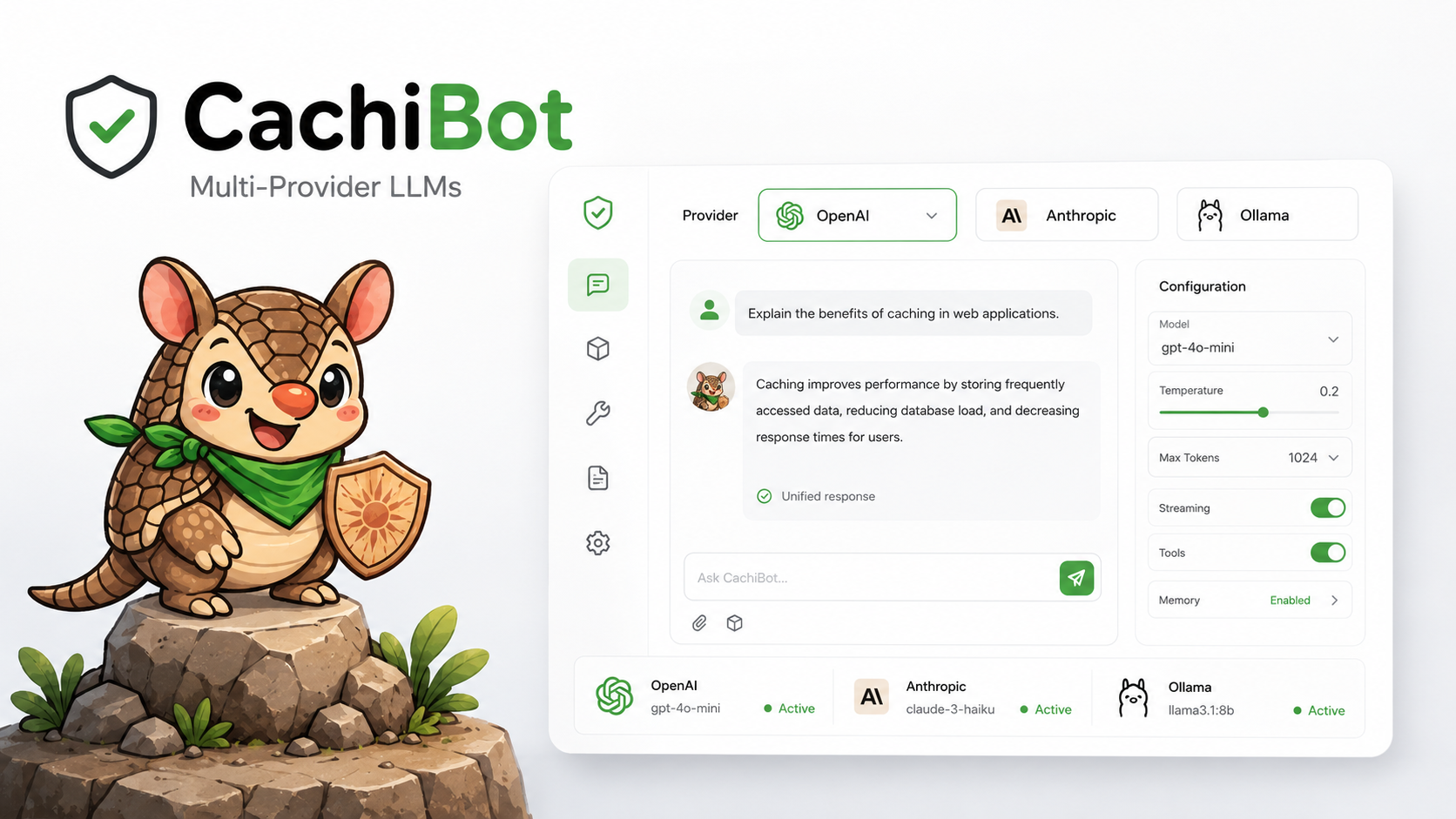
In the CachiBot dashboard, you can pick a provider from a dropdown:
Model: [OpenAI GPT-4o ▼]
       [Anthropic Claude 3.5 Sonnet]
       [Ollama llama3.1]
The agent engine instantiates the right provider class from the registry and passes it in. No code changes needed.
This is useful for:
- Cost optimization: Use cheaper models for simple tasks.
- Privacy: Route sensitive tasks to local models.
- Redundancy: Fall back to another provider if one is down.
- Benchmarking: Compare outputs side by side.
Local models with Ollama
For fully private deployments, CachiBot supports Ollama:
class OllamaProvider(LLMProvider):
    def __init__(self, base_url: str = "http://localhost:11434", model: str = "llama3.1"):
        self.base_url = base_url
        self.model = model

    def chat(self, messages, tools=None):
        # Convert to Ollama's chat format
        ...
Local models are slower and less capable for complex reasoning, but they’re perfect for tasks where data must stay on-premise.
Lessons learned
- Don’t trust provider schemas to stay stable. Abstract early.
- Normalize usage metrics. OpenAI returns tokens; Anthropic returns input/output tokens. CachiBot normalizes both into a common
Usageobject. - Handle streaming carefully. Each provider streams differently. CachiBot’s streaming layer unifies the event format.
- Test with real prompts. Provider behavior varies more than the docs suggest.
Explore the code
The provider system is in cachibot/providers/: github.com/jhd3197/CachiBot
If you’re building with multiple LLMs, this pattern will save you time.
Related posts: